



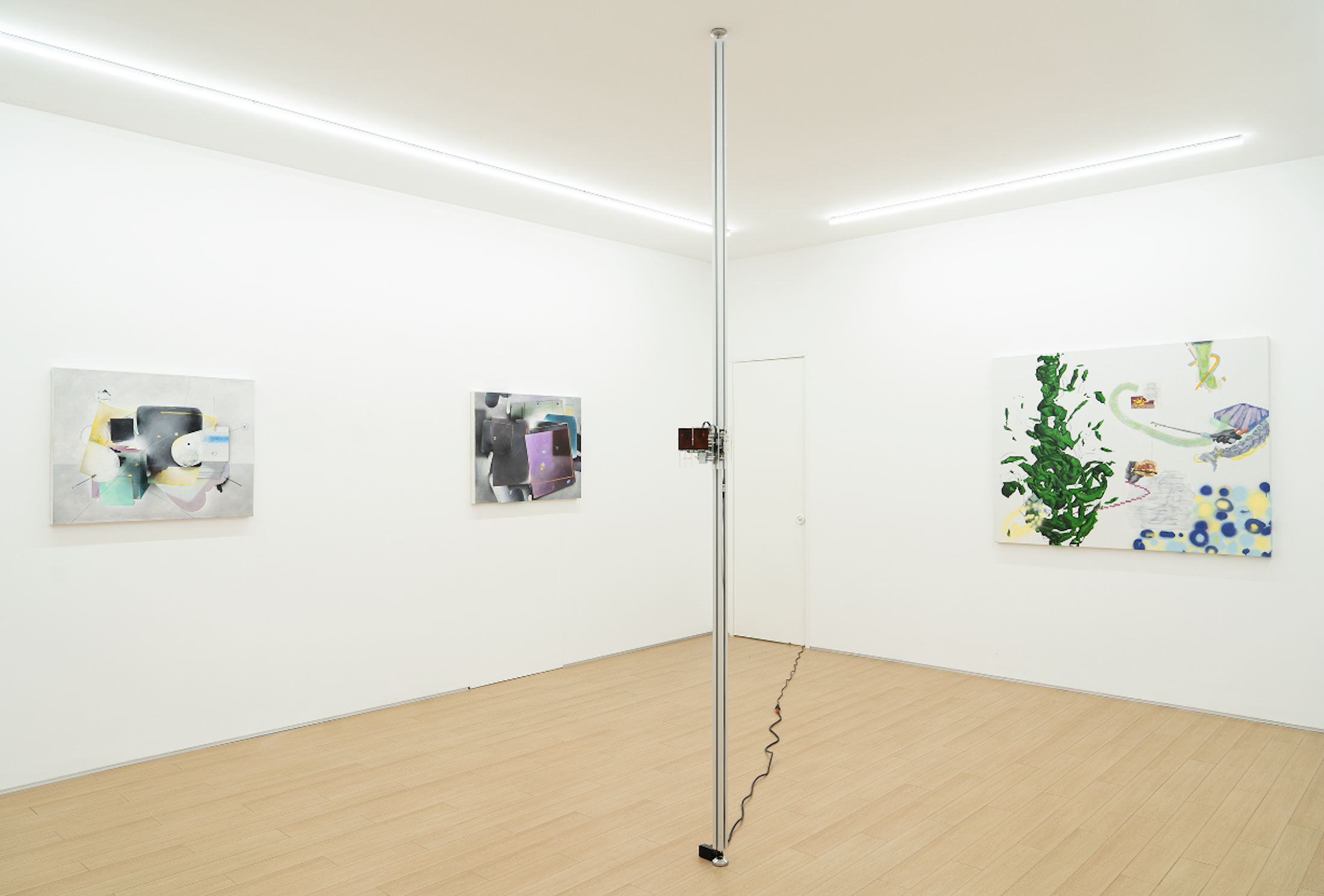

The group exhibition Autonomic disorder presents more than ten new works by five artists: Ding Shiwei, Li Qinbin, Luo Ran, Tang Shaohan, and Xie Chengxuan, including paintings and installations.
“As knowledge becomes more abstract and complex, the risk of becoming madness increases.” In the midst of the vast wave of global media transformation, where the economy and technology are rapidly expanding, and ideologies are evolving alongside shifts in the artistic landscape, modern life is accelerating the impact on the nervous systems of contemporary youth, saturated as it is in online media. In his work Art History as a History of Spirit, Devošek discussed, “In the past, when natural sciences dominated artistic thought, people often likened the development of art to the growth of plants. But today, we examine the development of art more from the perspective of constant conflicts between the spiritual content and formal expressions of art.” The theme of this exhibition, “Autonomic Disorder,” refers to autonomous nervous dysfunction, a syndrome caused by various psychological and social factors that induce a partial physiological dysfunction in the human body.
In the face of the vast and intricate web of online information and ever-evolving production tools, humans convey thoughts and their essence through language. The five artists invited to this exhibition each provide fresh interpretations of contemporary art phenomena from their distinct perspectives. Ding Shiwei’s works are presented through various media forms, such as image installations and video, in the context of screen-based experiences. He aims to explore digital media’s profound intervention and engagement in individual life experiences, shaping a future species reminiscent of a prophetic Frankenstein; Li Qinbin’s works navigate between abstract graphics and placements of manufactured objects, developing a concept known as “paradise construction.” With the introduction of computer vision algorithms, the imagery is transformed into an artificial texture, revealing a personal lineage in image selection; Luo Ran’s work endeavours to objectify tools. His works construct model images that function as illusionary spaces and action trajectories by discussing tools. He strives to create increasingly complex and structurally perfect images and then experiences and deconstructs them within paintings; Tang Shaohan’s work focuses on contemporary collective mental struggles and real-life contexts. He attempts to reflect on and organise this context’s intense yet hidden contradictions. Through a series of transformed images, he constructs a surreal and ineffable visual experience in a scattered manner; Xie Chengxuan’s works consciously combine the self with nature, responding to and experiencing the psyche through painting. He integrates the spirit of calligraphy into the language of painting and, through the connection between practice and theory, aims to deconstruct themes using various visual languages.
In this “neurosis” that is both “invisible and non-hidden,” it appears that art is being driven to confront one unanswerable question after another. As Žižek put it, “What do we do if the way we look at a problem is part of it?”
SELECTED WORKS
No works